
Look down the hallway in most Long Island homes this time of year and you will see it. There is a gray path from the front door to the kitchen, and a darker patch in front of the couch. Those are traffic lanes. In November they get worse fast, because wet leaves, lawn mud and the first road salt all come in on shoes. Here is why the lanes form, what you can do about them at home, and when it makes sense to book professional carpet cleaning on Long Island.
What a traffic lane really is
A traffic lane is not just dirt sitting on top of the carpet. It is three problems in the same strip.
- Oily soil. Shoes and bare feet leave a thin film of oil. Dust sticks to that film and turns the fibers gray.
- Sand and grit. Fine sand works down to the base of the carpet. Every step grinds it against the fibers like sandpaper. Homes near the South Shore beaches get a lot of this, and winter adds road salt and driveway sand.
- Crushed pile. The fibers get pressed flat and twisted. Flat fibers reflect light in a different way, so the lane looks darker even where it is clean.
That last point matters. Cleaning removes the soil and the grit, and it can lift the pile a lot. But if the fibers are worn down, no cleaning will make them new again. The sooner you deal with a lane, the more of the carpet you save.
Why Long Island carpets get lanes so fast in fall and winter
Our weather does much of the damage. In the fall, wet leaves and lawn mud get tracked in. From December on, rock salt and ice melt from sidewalks and driveways come inside on boots. Salt leaves a white, crusty mark. It also pulls in moisture, so the lane stays a little damp and grabs even more dirt. The same salt is hard on entry floors too, which we cover in our winter salt and slush guide for tile and grout.
Most homes here also have one main path. In a Hicksville cape, the whole family comes in through the side door, walks the same hall and stops at the same spot by the kitchen. In a Commack colonial, the path usually runs from the garage door, past the stairs, into the family room. Same steps, same strip of carpet, every day. Add Thanksgiving and December guests, and that strip takes a real beating.
How to slow down traffic lanes at home
You cannot stop people from walking on the carpet. You can cut down how much grit they bring with them.
- Put a mat outside and inside every door. A rough mat outside scrapes off sand and salt. A washable mat inside catches the rest. Shake them out often in winter.
- Take shoes off at the door. This one habit does more than anything else on this list. Keep a boot tray by the door so wet, salty boots have a place to drip.
- Vacuum the lanes slowly, in two directions. Go slow so the brush can pull grit from the base. Then make a second pass across the first one. Do the lanes more often than the rest of the room, a few times a week in winter.
- Check your vacuum. A full bag, a clogged hose or a brush roll wrapped in hair means you are only moving dirt around. Empty it and clean the brush.
- Move furniture a little. Shift the couch, chairs or coffee table a few inches now and then, so people walk a slightly different path.
- Use a runner where it fits. A runner in the hallway or a small rug in front of the couch takes the wear instead of your wall-to-wall carpet. When it gets dirty, wool runners and area rugs can go to our own rug cleaning facility, with free pickup and delivery. See our rug cleaning on Long Island page.
Tip: For white salt marks, blot with a towel dampened in warm water and a little white vinegar, then blot again with plain water. Test a hidden corner first, and do not scrub. If the marks come back after the carpet dries, the salt is deeper in the pile and needs extraction.
Spot cleaning a lane vs. deep cleaning it
Store sprays and home machines can make a lane look better for a few days. The trouble is what they leave behind. Most home products have soap in them. If the soap is not fully rinsed out, it stays in the fibers, stays sticky and pulls in dirt even faster. That is why some lanes come back darker a week after a home cleaning.
| Store spray | Rental machine | Professional hot-water extraction | |
|---|---|---|---|
| What it removes | Dirt on the tips of the fibers | Some soil, but often leaves soap behind | Oily soil, grit and old residue, rinsed out |
| Water left in the carpet | Very little | Often a lot, because suction is weak | Strong suction pulls most of the water back out |
| A week later | Lane often shows again | Can look darker if soap stayed in | Stays clean longer |
| Good for | Small fresh spills | Light touch-ups | Full rooms, halls and stairs |
How we clean traffic lanes
Lanes are part of every carpet cleaning job we do on Long Island. They are not an add-on. Here is what happens on the day:
- Walk-through. The technician looks at the lanes with you, points out any worn spots and gives you the price before any work starts.
- Dry soil removal. Heavy lanes get vacuumed first to pull out loose sand and grit.
- Pre-treatment. We spray the lanes with a Green Choice pre-treatment that breaks down the oily film. Our products are safe for kids and pets.
- Agitation. A brush works the solution into the pile, so it reaches the base and not just the tips.
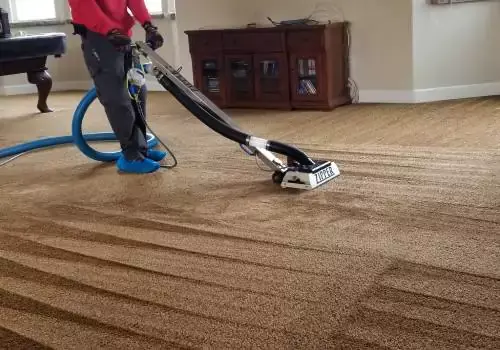
- Hot-water extraction. Steam cleaning rinses the loosened soil and the pre-treatment out of the carpet and pulls the water back up.
- Grooming. We brush the pile up so it dries standing tall. This helps the lane blend in with the rest of the room.
The carpet is usually dry within a few hours with good airflow. In winter, running the heat or a ceiling fan helps.
If the sofa sits right at the edge of a busy lane, its arms and seat cushions are usually just as gray. Many customers add sofa and upholstery cleaning in the same visit. Our current specials are 2 rooms for $99, first room only $49, and any sofa $69 for first-time clients, plus free stain protection. You save $20 when you book online. A minimum service charge applies. For a full look at what changes the price, read our guide on how much carpet cleaning costs on Long Island.
What NOT to do
- Don’t scrub the lane with a stiff brush and dish soap. It frays the fibers and leaves a sticky film behind.
- Don’t use bleach or oxygen powders on colored carpet. They can lighten the color and make the lane stand out more.
- Don’t soak the carpet with a rental machine. A wet pad under a hallway can smell musty for weeks. This is a real problem in Long Island basements and lower floors.
- Don’t wait until the lane is really bad. Grit cuts the fibers every day it stays in.
- Don’t walk on damp carpet in street shoes. Right after cleaning, use clean socks or slippers.
When to call a pro, and what to expect
It is time for professional cleaning when vacuuming no longer changes how the lane looks, when white salt marks keep coming back, or before guests arrive for the holidays. Many homes do well with a cleaning once a year, and twice a year with kids or pets. Stairs wear even faster than hallways, so we wrote a separate guide on stair carpet cleaning on Long Island.
A good company will be honest about results. Most gray lanes come out well. Lanes that are many years old may get much lighter but still show some shading where the pile is worn or crushed. That is wear, not dirt, and we tell you that before we start, not after. If a spot we treated comes back, our 100% satisfaction guarantee means we come back and re-clean it for free.
We are open 24 hours, 7 days a week, including holidays, and same-day service is often available across Nassau and Suffolk County. Our certified technicians have been cleaning Long Island carpets since 2005. We clean busy family homes every day, from carpet cleaning in Hicksville and Commack to Bay Shore, where beach sand and road salt end up on hallway carpet all winter.
Frequently asked questions
Can carpet traffic lanes be removed completely?
Most can. The soil, grit and oily film rinse out with hot-water extraction. If the fibers are worn or crushed, some shading can stay, because that is wear, not dirt. We tell you before we start.
Why does a traffic lane come back after a home cleaning?
Usually it is soap residue. Store sprays and rental machines often leave soap in the carpet, and that sticky film pulls in new dirt. A full rinse with hot-water extraction takes the residue out.
How often should traffic lanes be cleaned by a professional?
For most Long Island homes, once a year is a good plan. With kids, pets or a busy side door, twice a year keeps the grit from wearing down the fibers.
How long does carpet take to dry after cleaning?
Usually within a few hours with good airflow. Running the heat or a ceiling fan helps, especially in winter.
Do you clean traffic lanes on stairs and in hallways?
Yes. Halls and stairs get the heaviest traffic, so we pre-treat them and clean each step by hand. Tell us how many steps you have when you book.
We are open 24 hours, 7 days a week across Nassau & Suffolk. Certified technicians, kid & pet safe products and a 100% satisfaction guarantee. Right now: 2 rooms $99 or first room $49*. Book online and save $20.
*Minimum service charge applies.
