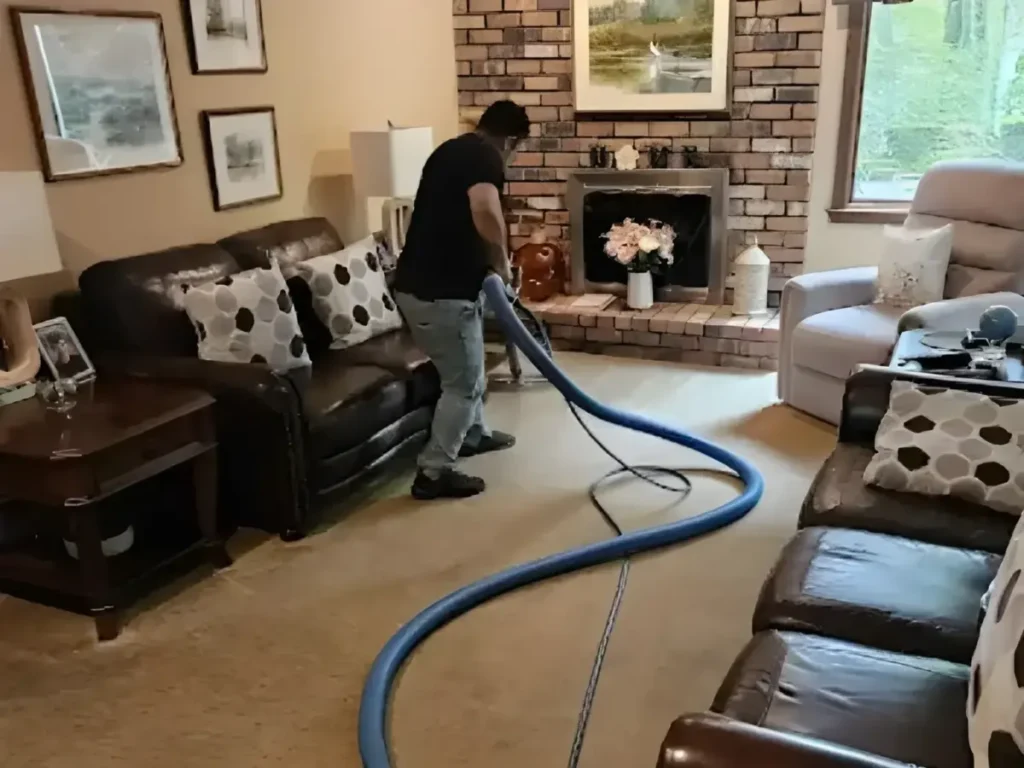
The first hard cold snap of the season reaches Long Island, and a pipe inside an outside wall freezes overnight. Nothing happens until the next afternoon. Then the ice thaws, water sprays inside the wall, runs under the baseboard and soaks the bedroom carpet. Or it is a summer house in Westhampton that nobody has opened since October, and a split pipe has been leaking for days before a neighbor sees water under the door. In both cases, what you do in the first hour decides how much carpet, pad and floor you lose. This guide covers the first steps, how to tell if the carpet can be saved, what NOT to do, and when to call for emergency water extraction.

Why pipes burst on Long Island in late fall and winter
A frozen pipe rarely floods the house while it is frozen. Ice swells inside the pipe and splits it, but the ice also plugs the crack. The flood starts when the pipe thaws and full water pressure pushes through the split. That is why so many burst pipe calls come in on a sunny afternoon after a freezing night. These are the spots we see most often:
- Pipes in outside walls. Kitchen and bathroom lines on a north-facing wall get the least heat and freeze first.
- Garages and crawl spaces. Many capes and ranches have an addition over a crawl space with pipes running through it. Cold air gets in and the pipe has no protection.
- Outdoor spigots. A hose left connected traps water in the spigot. It freezes, the pipe behind the wall cracks, and the leak shows up inside the house.
- Homes left empty. Second homes in the Hamptons and on the East End often sit closed all winter. A family away for Thanksgiving may turn the heat down too far. Nobody is there to hear the water running.
The first hour: what to do right away
Shut off the water
Close the main water valve first. In most Long Island homes with a basement, it sits on the front wall where the water line comes in from the street, near the meter. In slab homes it is often in a utility closet or the garage. If you cannot find it or it will not turn, call your water district for help with the curb valve.
Be careful with electricity and ceilings
If water is coming through a ceiling near a light fixture, or it is near outlets or a power strip, turn off that circuit at the panel. Only do this if you can stand on a dry floor at the panel. A ceiling that bulges or sags is holding water and can come down. Do not stand under it, and keep kids and pets out of the room.
Take photos before you move anything
Photograph the broken pipe, the wet carpet, the walls and the ceiling. Your insurance company will want to see the damage as it was, and it is much harder to show later.
Get things off the wet carpet
Move furniture, boxes and electronics to a dry room. For heavy pieces that cannot move, put foil or small wood blocks under the legs so wood stain and rust do not bleed into the carpet. Roll up area rugs and take them out. A wool or Oriental rug that sits in water can bleed dye fast.
Start airflow
Run fans and a dehumidifier and keep the heat at a normal setting. Open a window only if the air outside is drier than the room. Light dampness on the surface usually dries within a few hours with good airflow. A soaked pad will not dry with a box fan.
Tip: Pull up one corner of the carpet with pliers and press on the pad. If water comes up, the pad is soaked. Water trapped in the pad is what causes mold, a musty smell and damage to the subfloor.
Can the carpet be saved after a burst pipe?
Most burst pipes carry clean water from the supply line, which is good news. But the path the water takes changes things. Here is how it usually plays out:
| Situation | Water condition | Carpet | Pad |
|---|---|---|---|
| Supply pipe burst, found and stopped fast | Clean | Usually saved | Often saved if extracted quickly |
| Water came through a ceiling, insulation or wall | Picks up dirt and debris on the way | Often saved with cleaning | Often replaced |
| Leak ran for days in an empty house | No longer clean | Sometimes saved, check for mold | Almost always replaced |
| Water heater or boiler leak | Clean, but may carry rust or sediment | Usually saved, rust spots may need extra work | Depends on how long it sat |
Clean water does not stay clean. Once it sits in the carpet and pad, it picks up dirt from the floor and starts to act like gray water.
Where the water hides
A carpet can look fine on top while the real problem sits underneath. After a burst pipe, water spreads in places you cannot see:
- Under the pad along the walls. Water runs to the edges and soaks the tack strip and the bottom of the drywall.
- Into the room below. A pipe that breaks on the second floor of a Huntington colonial often soaks the first floor ceiling and the carpet under it too.
- Down the stairs. Stair carpet pulls water down each step and into the pad on the landing.
- Back up to the surface. As carpet dries, dirt and dye from the backing can wick up and leave brown rings. This is called wicking, and it is why a quick surface wipe is not enough.
What NOT to do
- Do not thaw a frozen pipe with an open flame or a heat gun. It is a real fire risk inside walls. Use a hair dryer or call a plumber.
- Do not turn the heat way up to dry the room. Heat without airflow and a dehumidifier makes the room warm and damp, which mold loves.
- Do not rip out and throw away carpet before photos. Your insurance adjuster may need to see it, and a lot of it can often be saved.
- Do not rent a carpet cleaning machine. Rental units are made to clean, not to pull water out of a soaked pad.
- Do not wait to see if it dries. The carpet may feel dry on top while the pad stays wet underneath for much longer.
When to call a pro, and what to expect
Call for help if more than a small spot got wet, if the pad is soaked, if water came through a ceiling, or if the leak ran while nobody was home. Our 24/7 emergency water extraction on Long Island is set up for exactly this. We are open 24 hours a day, 7 days a week, including holidays, so a pipe that bursts on Thanksgiving morning or at 3 a.m. is not a problem. Call (516) 894-2919 and tell us what happened.
Here is how a visit usually goes:
- Inspection. Our certified technicians check where the water went, test the carpet, pad and walls with a moisture meter, and tell you honestly what can be saved.
- Water extraction. We pull the water out of the carpet and pad with powerful extraction equipment. The more water we remove, the faster the room dries.
- Pad decision. If the pad is clean and only wet, it can often be dried in place. If it sat too long or water came through a ceiling, we recommend replacing it.
- Drying. We set up air movers and dehumidifiers. With good airflow, most rooms usually dry within a few hours. A deep soak or a long leak takes longer.
- Cleaning. Once it is dry, we clean the carpet with hot-water extraction (steam cleaning) and Green Choice products that are safe for kids and pets.
We tell you the truth about results. Carpet hit by clean water and handled the same day often comes back looking good. If a water ring or spot comes back after we clean, our 100% satisfaction guarantee means a free re-clean.
If area rugs got wet, our free rug pickup and delivery takes them to our own facility for a full rug cleaning on Long Island. Our guide to water-damaged rug cleaning explains which wet rugs can be saved. After the emergency, many homeowners also book carpet cleaning on Long Island for the rest of the house before guests arrive. Right now 2 rooms are $99, or the first room only is $49 (a minimum service charge applies). You save $20 when you book online, and same-day service is often available. If the water came from a storm and not a pipe, see our guide to a flooded basement carpet instead.
Burst pipes across Nassau and Suffolk
We have handled water calls all over Long Island since 2005, and every part of the island has its own weak spots. In Levittown, slab homes and old additions over crawl spaces are common trouble areas. Older colonials in Huntington often have pipes in outside walls and a finished second floor right above the living room. Out east in Southampton, the big risk is a closed-up summer home where a leak runs for days before anyone knows.
How to keep pipes from freezing this winter
- Disconnect garden hoses and shut off and drain outdoor spigots before the first freeze.
- Wrap pipes in garages, crawl spaces and unheated rooms with foam pipe insulation.
- Never turn the heat off when you travel. Keep it at a normal low setting.
- On very cold nights, open the cabinet doors under sinks on outside walls and let a faucet drip.
- Have someone check a closed-up summer house every week, or ask a plumber to winterize it.
Frequently asked questions
Can wet carpet be saved after a burst pipe?
Often yes. Most burst pipes carry clean water, and carpet that is extracted and dried the same day usually comes back well. The pad is more likely to need replacing, especially if the water came through a ceiling or sat for a long time.
Is water from a burst pipe clean water?
It starts out clean because it comes from your supply line. But it picks up dirt as it runs through walls, ceilings, insulation and the carpet itself, so the longer it sits, the less clean it becomes.
How long can wet carpet sit before mold starts?
There is no safe waiting period. The longer the pad stays wet, the higher the chance of mold, odor and subfloor damage. Call for water extraction the same day you find the leak.
Will homeowners insurance pay for burst pipe water damage?
Many policies cover sudden water damage from a burst pipe, but not slow leaks or damage from a house left without heat. Every policy is different, so call your agent. Photos and quick action help your claim.
Do you come out at night or on holidays for a burst pipe?
Yes. We are open 24 hours a day, 7 days a week, including holidays, and we offer emergency water extraction across Nassau and Suffolk County.
We are open 24 hours, 7 days a week across Nassau & Suffolk. Certified technicians, kid & pet safe products and a 100% satisfaction guarantee. Right now: 2 rooms $99 or first room $49*. Book online and save $20.
*Minimum service charge applies.